QUICK ANSWER
A water-related label or suspicious photograph is a reason to investigate, not a complete diagnosis. A dry, clean interior is not enough to rule out prior water exposure.
Begin with the recorded history
Look for water or flood descriptions, loss-type entries, document notes and photographs from earlier listings. Compare their dates and the vehicle identifiers. A later clean photograph does not erase an earlier observation.
The FTC warns that flood-damaged vehicles may be cleaned up and resold. Use that as a reason to verify the history and arrange inspection, not as evidence that any individual car has been flooded.
Ask for evidence from specific areas
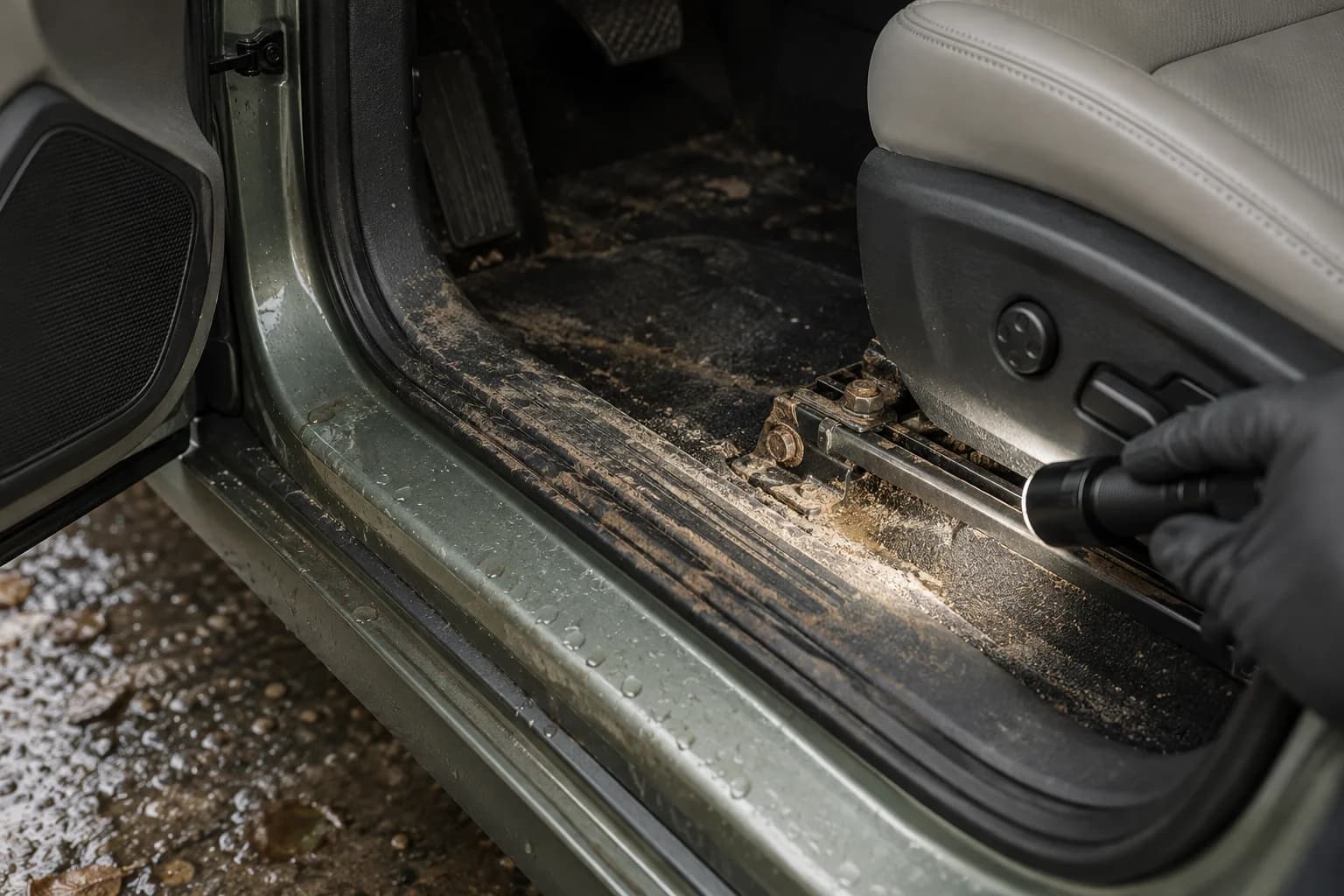
Request close, well-lit views of the footwells, seat rails, luggage compartment and accessible connectors. Look for inconsistencies that need explaining: sediment, unusual staining or corrosion, or recently replaced trim next to older surrounding parts. A photograph cannot establish the exposure depth or whether hidden components were affected.
Do not ask an unqualified person to energise or dismantle a potentially water-damaged vehicle for a video. Have an appropriately qualified inspector decide how to assess it safely, particularly if electrical or high-voltage components may be involved.
Build a question list for the inspector
Keep the inspection request concrete.
| Question | Why it matters to the decision |
|---|---|
| What evidence of water exposure is present? | Separates observation from a seller’s explanation |
| Which systems could not be assessed? | Identifies unknowns instead of silently passing them |
| What repairs or replacements are documented? | Connects the historical condition with the current one |
| What further specialist checks are needed? | Defines the next cost before bidding |
Do not reduce the decision to cleaning cost
A detailing quote and a diagnosis answer different questions. Ask for a written scope, the limitations of the assessment and any follow-up work. NHTSA notes that flood-related problems may not appear immediately; a short successful start is therefore not a complete history assessment.
If the evidence remains contradictory or the potential work cannot be bounded within your project, do not let a low bid stand in for an inspection. Compare another vehicle whose condition and documentation can be explained more clearly.
Before you decide
- Compare old and new records.
- Request close-up evidence from hidden interior areas.
- Use a qualified inspection with a written scope.
- Separate cleaning from diagnosis and repair.
- Keep unresolved water exposure visible in the purchase decision.
Common questions
Can an interior smell prove or disprove flood damage?
No. It is one observation to discuss with an inspector, not a standalone conclusion.
Does a starting engine clear the water-damage concern?
No. It does not establish the condition of every affected system.
Sources & scope
Primary sources checked on October 9, 2026. Platform rules and jurisdiction requirements can change; verify the conditions applicable to your transaction. Examples and checklists are editorial suggestions.
Start with a specific VIN
Apply the guide to the vehicle records available in our archive.