QUICK ANSWER
A damage label is a description in the listing, not a repair quotation. Read primary and secondary damage together, then check what the photographs and inspection actually establish.
Separate the label from the diagnosis
A front-end label describes an area. It does not tell you whether the work is limited to a bumper or extends to cooling, suspension or structural components. A secondary label can add another area of concern; it is not a reliable ranking of repair expense.
Use the source wording in your notes. Translating a short label into a confident diagnosis creates false precision. “Mechanical” should lead to a request for diagnostic evidence, not a guess that the engine must be replaced.
Use each description to ask a better question
The following is a research checklist, not a claim that every car with this label has the same defect.
| Listing description | What to investigate |
|---|---|
| Front or rear impact | Panel gaps, mounting points, hidden components and measurements |
| Side damage | Doors, pillars, sill, wheel position and restraint-system evidence |
| Undercarriage | Inspection underneath the vehicle and component clearances |
| Mechanical | Fault codes, test conditions and a written diagnostic opinion |
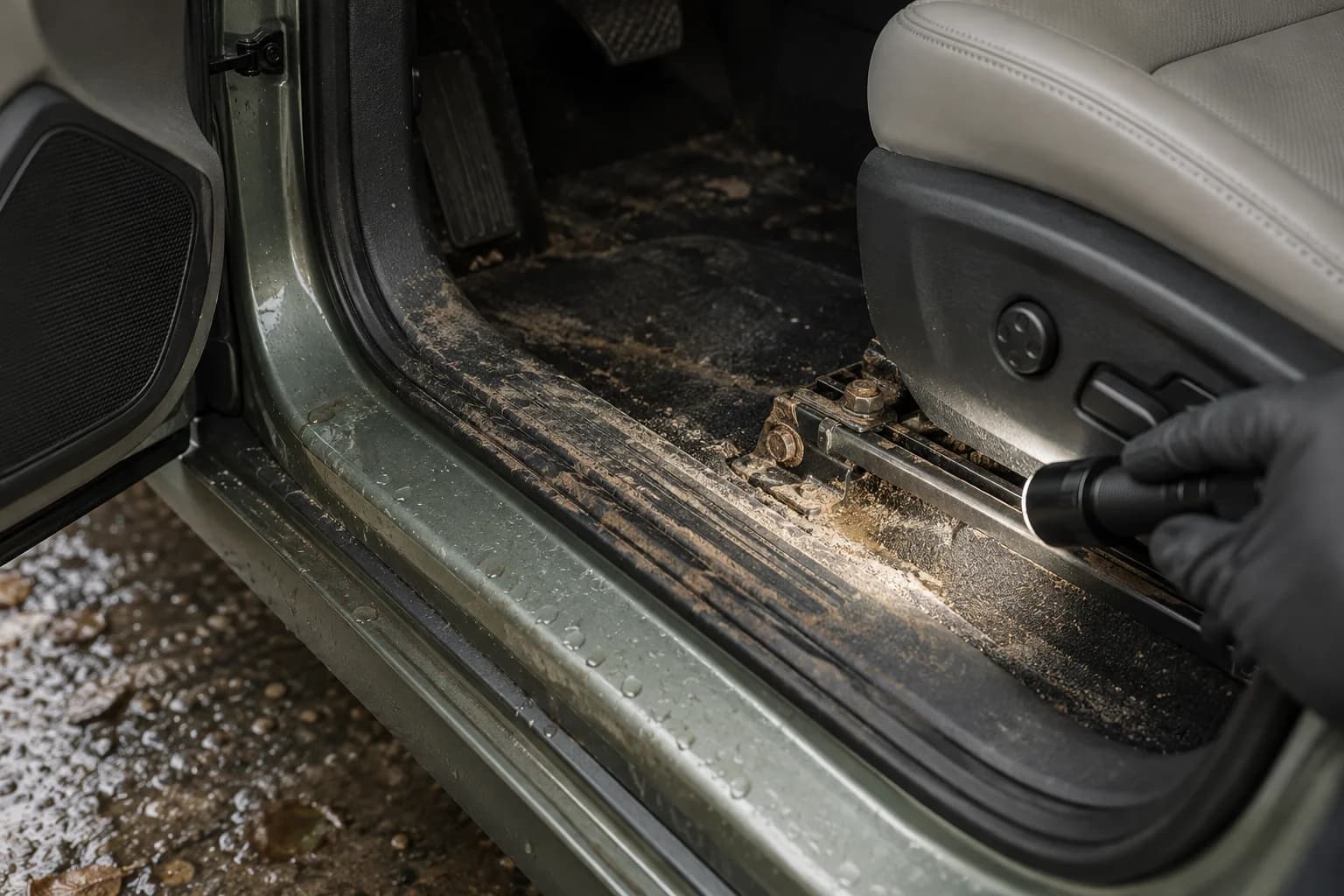
| Water / flood | Water exposure, contamination and a specialist inspection |
| Hail or scratches | Panel-by-panel estimate rather than a single generic allowance |
Compare at least three layers of evidence
First read the labels. Next inspect the photo sequence rather than the best-looking hero photograph. Finally compare both with an independent inspection. When these disagree, keep the disagreement visible until it is resolved.
Imagine a lot marked “rear damage” whose photographs also show an unusually positioned front wheel. Do not silently reclassify the car yourself. Ask the inspector to examine that wheel, suspension and mounting area, and include the uncertainty in your decision.
Convert uncertainty into a budget
Ask the repairer to separate visible replacement parts, labour, diagnostic work and work that cannot be priced until dismantling. Put the confirmed amount and a contingency into separate calculator fields. A reserve is a planning choice; it is not evidence that the repair can be completed for that amount.
If the seller cannot provide access or the unknown work could change whether the car is repairable for your intended use, pausing the bid is more informative than adding an arbitrary percentage.
Before you decide
- Read both damage fields.
- Compare all available views and dates.
- List contradictions instead of explaining them away.
- Get a written scope and exclusions for repair estimates.
- Check documentation and registration suitability separately from physical damage.
Common questions
Is secondary damage always cheaper to repair?
No. Treat the two labels as descriptions, not a cost ranking.
Can a clean-looking photo rule out structural damage?
No. A photograph does not provide measurements or reveal every hidden component.
Sources & scope
Primary sources checked on October 9, 2026. Platform rules and jurisdiction requirements can change; verify the conditions applicable to your transaction. Examples and checklists are editorial suggestions.
Start with a specific VIN
Apply the guide to the vehicle records available in our archive.